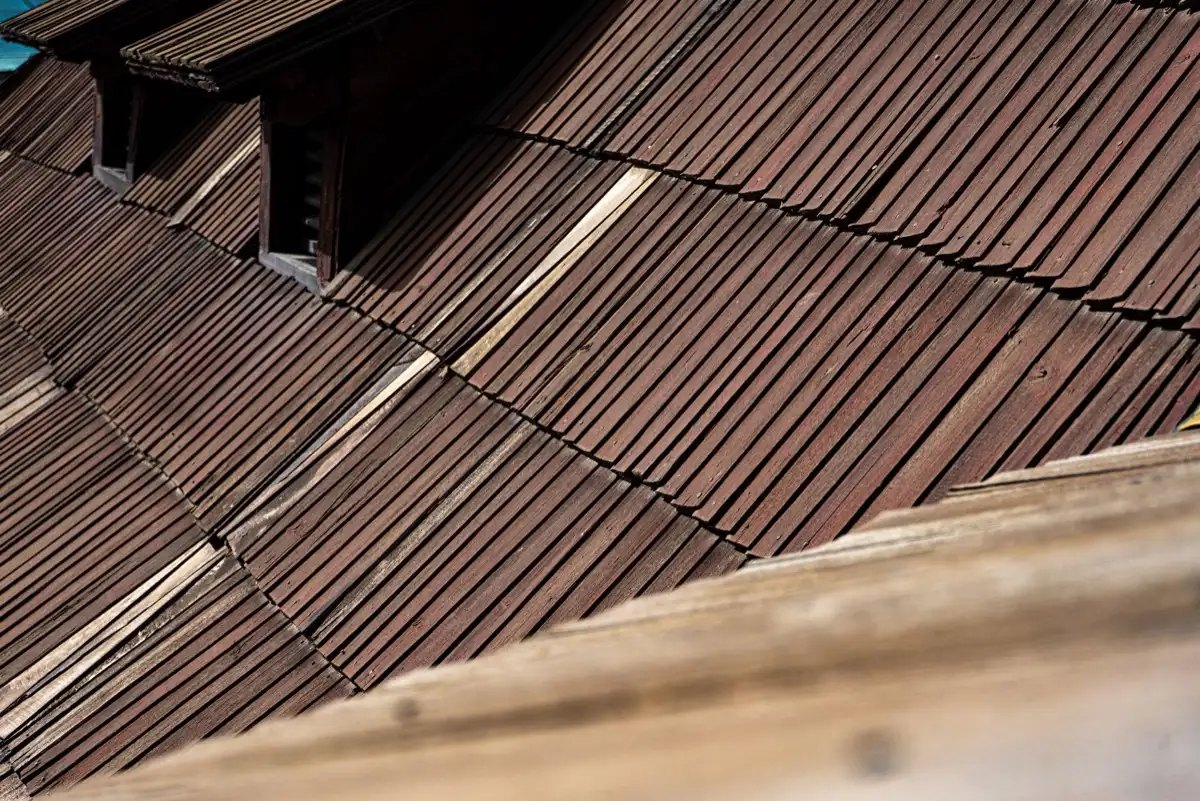
A 3-tab shingle is one layer of asphalt with two slots cut in it. An architectural shingle is two layers bonded together. Weight, wind rating, warranty term, how the roof ages and how it reads from the sidewalk all fall out of that one difference. The rest is commentary.
Which is why the argument is largely over. On new residential work in most markets, one of the two quietly stopped being an option.
One layer, two layers
A 3-tab — the trade calls it a strip shingle — is one strip of fiberglass mat saturated with asphalt and surfaced with granules, with two slots cut into the bottom edge so each shingle reads as three tabs. Uniform thickness end to end, cutouts lining up down the roof.
An architectural shingle is a base strip with a second, shaped layer laminated onto the exposed portion. That layer is the entire product difference.
| 3-tab (strip) | Architectural (laminate) | |
|---|---|---|
| Construction | One layer, two cutouts | Two layers bonded |
| Weight per square | Roughly 200–250 lb | Roughly 250–400 lb, premium lines higher |
| Common wind classification | Often the bottom class, near 60 mph | Commonly the top class on both scales |
| Headline warranty | Around 25 years, limited | "Lifetime limited," commonly defined as 50 |
| Pattern from the street | Repeating, ruler-straight | Staggered, irregular, shadowed |
| Availability | Thinning fast | The default |
Weight is the honest proxy for the rest of it. Asphalt is what resists tearing, holds a nail and keeps a seal strip stuck down, and architectural carries half again to double as much of it.
Warranty term is not service life. Both land below their ratings, and ventilation explains most of the gap — see how long a roof actually lasts.
What are architectural shingles, specifically
Architectural, dimensional and laminate all name the same product. Laminate tells you the most, because it describes the making of it: two layers bonded, the upper one cut in an irregular pattern so courses throw a shadow instead of a line.
The original point was cosmetic — asphalt wanted to look like wood shake and slate, and a flat strip shingle never will. The side effect mattered more. Doubling the material through the exposed zone gives a thicker nail zone, a heavier tab for wind to fight and a broader sealant area. The aesthetic upgrade accidentally became a structural one, which is why architectural took over.
One thing people meet on install day: you cannot cut hip and ridge caps out of architectural shingles the way roofers cut them out of 3-tabs for decades. The laminate is too thick to bend cleanly. Purpose-made cap is a separate line item, so if a bid does not name one, ask what is going on the ridge.
Composition, architectural, and the one word people mix up
Half the reason anyone searches "composition vs architectural" is that the words sound like rival products. They are not comparable categories.
Composition — often shortened to comp, and used constantly on the West Coast — is a general term for asphalt shingle: a fiberglass or organic mat, asphalt and mineral granules pressed together. It says what the shingle is made of. A 3-tab is a composition shingle. So is an architectural. Asking whether you want composition or architectural is like asking for a car or a sedan.
Composite, one letter away, is a different product: molded polymer imitating slate or shake, at multiples of asphalt pricing. When somebody says "comp roof" they mean asphalt. When a bid says composite, read it twice.
What the second layer buys in wind
This is where the two stop being a preference.
Asphalt shingles are classified for wind two ways. ASTM D3161 blows air at them with a wall of fans: Class A passes at 60 mph, Class D at 90, Class F at 110. ASTM D7158 measures the uplift force needed to break the sealant bond: Class D at 90 mph, Class G at 120, Class H at 150. A product reaching Class F on the first usually reaches Class H on the second.
IRC section R905.2.6.1 requires shingles to be classified to the basic wind speed for the site — D3161 Class D or D7158 Class G at the lower speeds, Class F or Class H at all wind speeds — with the class printed on the wrapper.
Read that against a bottom-class 3-tab at roughly 60 mph. Across a large share of the map, an entry strip shingle is not a value choice. It is a product that does not clear the wind speed for that address.
Two things beat the wrapper, though. The fastening schedule — four fasteners per strip shingle normally, six in high-wind areas — is code, and a shingle nailed above its nail line carries no rating at all. And the class assumes the seal strip sealed, which needs sun: a roof laid in a cold snap is unrated until spring, whichever product it is.
Cost for architectural shingles, honestly
Published guides disagree here by more than three times, and the disagreement is scope rather than sloppiness. Guides quoting bundle or material-only prices show architectural at roughly two to four times 3-tab. Guides quoting installed roofs show a far narrower gap — often under a dollar a square foot, or a quarter to a half above 3-tab on the same roof.
The installed figures are the ones you pay, because tear-off, underlayment, flashing, ventilation, disposal, permit and crew time are identical whichever shingle goes on. Doubling the shingle does not double the roof.
The ratio worth carrying: architectural adds a modest fraction to the price and a large fraction to the wind class and the warranty. What actually moves the total is in our roof replacement cost guide.
Why 3-tab all but vanished
Not by ban. By attrition, and the numbers are stark. Itel's analysis found available 3-tab product lines in the United States fell about 68 percent over five years, and that in more than half of cases no equivalent product is left on the market for a partial repair. In the Northeast, nearly two-thirds of homes with asphalt shingle claims in one recent year had 3-tab roofs — aging roofs with a shrinking supply of parts.
Four forces did it. Wind classification requirements tightened until strip shingles stopped clearing code in much of the country. The installed price gap turned out to be small, so buyers took the upgrade. Insurers tired of partial repairs on discontinued colors. And manufacturers holding a thin-margin product cut lines until 3-tab became a phone call rather than a pallet on the shelf.
That last one bites homeowners: a 3-tab roof laid fifteen years ago has a parts problem, and a claim on it ends in a whole slope more often than a tidy repair.
Where 3-tab is still the right call
We still specify it, deliberately, in three situations.
Outbuildings. Detached garage, shed, workshop, porch cover. Nobody photographs the shed, and it never sees two-story wind.
Working with an existing roof. If most of a roof is sound 3-tab and one slope needs work, architectural on that slope leaves a visible line across the house and a step at the ridge. Where the original product is obtainable, use it.
A rental or a near-term sale. A 25-year product on a building you will hold six years is correct sizing, not a compromise. The reverse — a 50-year shingle on a house you list in the spring — is money handed to the next owner.
Who Maryland lets install either one
The shingle is a product decision. Who is allowed to nail it down, and what they may promise you about paying for it, is set by your state.
The credential is an MHIC license from the Home Improvement Commission, and the number to know is that there is no dollar threshold at all - any home improvement work needs one, whatever it costs. Your deposit is capped at one third, and no money may be taken before you sign. The guaranty fund pays up to thirty thousand dollars per claimant, but only against a licensed contractor, and an unlicensed one cannot enforce the contract against you.
That second point has a shingle-specific flavor. After a storm, "we'll upgrade you to architectural for free" is a standing offer in every damaged neighborhood, and where the upgrade is really being funded by a deductible nobody intends to collect, the offer is the problem.
Maryland treats this as a fraudulent insurance act, and grades it a felony once three hundred dollars is involved - up to ten thousand dollars and fifteen years, with the fine mandatory and not subject to suspension. Three limits matter, though: it reaches weather damage only, applies only where payment comes from policy proceeds, and requires intent to defraud the insurer. Unlike some states, Maryland does not separately ban advertising the practice.
How each one fails, and what pitch does to the choice
A 3-tab fails by the tab. The seal strip releases, the tab lifts, wind folds it back and it creases or tears off. Because the cutouts run straight down the roof, a lifted tab opens a direct path to the course beneath rather than a lapped one. Failures are scattered, individual, obvious from the ground.
An architectural fails by the surface. Granule loss, blistering, then separation between the laminated layers along the exposed edge. Whole pieces leave less often, so the roof looks tired for years before it looks broken — which is why people run them past the point a written roof inspection would have called it.
Pitch settles nothing on code — asphalt of either kind is permitted only on slopes of 2:12 and steeper, with doubled underlayment from 2:12 to 4:12. It settles a lot on looks. On a shallow slope you see the roof nearly edge-on and the shadow lines mostly disappear, so you are buying wind class rather than appearance. On a steep street-facing plane, texture is the most visible material decision on the house. And there is a reason nobody puts 3-tab on a wavy old deck anymore: those ruler-straight cutouts work like a straightedge laid across the roof, so every hump and tired sheet of sheathing telegraphs through. A staggered laminate hides the same deck.
Bottom line
Architectural is two layers, 3-tab is one, and the second layer buys weight, wind class and warranty for a fraction more installed. Buy architectural unless you have a specific reason not to — an outbuilding, an existing 3-tab roof you are working into, a short ownership horizon. None of those is about saving money on the shingle. The shingle was never the expensive part.
Columbia MD Roof Pros installs and repairs asphalt shingle roofs of both kinds, along with roof replacement and storm damage restoration across Columbia and Howard County. Call (866) 814-0634 and we will price your actual roof both ways, including telling you when the cheaper shingle is the right one.
Ready for a free quote in Columbia?
Columbia MD Roof Pros — free estimate, clear scope, no pressure. Use the form on this page or jump to the homepage quote.
Related services in Columbia
Columbia MD Roof Pros money pages — go straight to the service you need.
- Roof Replacement →
A Columbia roof replacement runs on two clocks. Howard County issues the permit and sends an inspector.
- Storm Damage Restoration →
The dangerous part of a storm in Columbia is not the storm. It is the crew that knocks on the door two days later offering to have a new roof on by the weekend, on a lot where the color has to be approved by a committee that meets monthly.
- Asphalt Shingle Roofs →
Asphalt shingle is what almost every roof in Columbia is and what almost every roof in Columbia should stay. The engineering decision is easy.
- Roof Leak Repair →
Almost every Columbia roof we are called to look at is leaking at a detail, not failing across the field. Boots, valleys, wall terminations, chimney counter-flashing.
- Hail Damage Roof Repair →
Central Maryland is not hail country, and we would rather say that out loud than build a business on pretending otherwise. On a Howard County roof, most of what gets called hail damage turns out to be granule loss from age, foot traffic left by another trade, or blistering.
Frequently asked questions
What is the difference between 3-tab and architectural shingles?
One layer versus two. A 3-tab shingle is a single strip of asphalt-saturated mat with two slots cut in the bottom edge so it reads as three tabs. An architectural shingle is a base strip with a second shaped layer laminated onto the exposed portion. Everything else people compare — weight per square, wind class, warranty term, how the roof looks from the street, how it eventually fails — is downstream of that one manufacturing difference.
What are architectural shingles?
Architectural, dimensional and laminate are three names for the same product: a two-layer asphalt shingle. The second layer is cut in an irregular pattern and bonded across the exposed face, so courses cast shadow lines and no two rows read alike. That was the original design intent, to imitate the depth of wood shake or slate at asphalt prices.
The side effect turned out to matter more than the look: twice the material in the exposed zone means more weight, a stronger seal and a much higher wind class.
Are composition shingles the same as architectural shingles?
Composition is the category and architectural is one shape inside it. In much of the country, and especially on the West Coast, composition or comp shingle just means asphalt shingle — a fiberglass mat, asphalt and mineral granules. So a 3-tab is a composition shingle and an architectural is a composition shingle. Watch the near-identical word composite, though.
Composite shingles are molded polymer products imitating slate or shake, they are a different material at a different price, and the two words get used as if they were one.
How much more do architectural shingles cost than 3-tab?
Less than you would guess from the bundle price, because you are buying labor as well as material. Published guides disagree wildly here: some show a three-to-four-times gap, others put installed architectural only a fraction above installed 3-tab.
The narrower figures are the honest ones for a re-roof, because tear-off, underlayment, flashing, ventilation, disposal and crew time are identical either way and the shingle is a minority of the total. Ask your contractor to price both on the same scope sheet and read the difference in dollars, not in multiples.
Are 3-tab shingles being discontinued?
Not banned, but thinned out aggressively. Itel's analysis found the number of 3-tab product lines available in the United States fell by about 68 percent over five years, and that in more than half of cases there is no equivalent product left on the market for a partial repair. Manufacturers have not announced an end date. They have quietly cut colors and lines until 3-tab became a special order in many markets.
Which holds up better in wind?
Architectural, by a wide margin, and building code has noticed. Asphalt shingles are classified for wind under ASTM D3161 or ASTM D7158, and the IRC requires that classification to meet the basic wind speed for your location. Entry 3-tab products commonly sit at the bottom class, around 60 mph.
Mainstream architectural products are commonly classified at the top of both scales. Fastening matters as much as the product: the code calls for four fasteners per strip shingle normally and six in high-wind areas, and a shingle nailed above its nail line is unrated regardless of what the wrapper says.
Local context
How this applies in Columbia, MD
Every article here is written from roofing work done in Columbia and Howard County, so the numbers reflect local labour, permit and material costs rather than a national average. Your own job can land either side of them depending on access, the condition of what is already there, and the materials you pick — low-profile static vents kept below the ridge line, pipe boots and vent stacks painted out to the field color, half-inch CDX re-sheathing over gapped original panels.
The way to turn any of this into a real answer is to have someone look at your actual situation. The free estimate is free, itemized and written down, with no deposit and no obligation. Call (866) 814-0634 or start on the Columbia MD Roof Pros homepage.
Areas Columbia MD Roof Pros covers
Columbia first, then the surrounding communities of Howard County. Each has its own page with local detail rather than a copy of this one:
- Ellicott City, MD — Howard County, population 75,947
- Elkridge, MD — Howard County, population 25,171
- Ilchester, MD — Howard County, population 26,824
- North Laurel, MD — Howard County, population 25,379
- Scaggsville, MD — Howard County, population 9,217
- Savage, MD — Howard County, population 7,542
Or jump to the full list of Columbia services.
More from the Columbia MD Roof Pros blog
- Roof Replacement Cost in Columbia, MD: What Drives the Number
Roof replacement is priced per square, not per house. Here's what actually moves the bid in Columbia, MD, and which line items are worth paying for.
- Roof Inspection Cost in Columbia, MD: What You Get for the Money
A real roof inspection produces a photographed, slope-by-slope report. Here's what one costs in Columbia, MD, and how to tell it from a sales visit.
- Metal Roof vs Shingles in Columbia, MD: The Honest Comparison
Metal costs roughly two to three times what asphalt does and lasts two to three times as long. Here's when that math works in Columbia, MD, and when it doesn't.
The Columbia MD Roof Pros Team
roofing specialists serving Columbia, MD
Written by the Columbia MD Roof Pros team — insured roofing pros serving Columbia, MD and the surrounding area.